

Sitio sobre Santo Tomás de Aquino -su vida, su obra, su filosofía y sus discípulos- que reemplaza a los anteriores www.Geocities.com/Tomistas y StThAquinas.8m.com (en internet desde Agosto de 1999)
Mostrando las entradas con la etiqueta Filosofía Medieval. Mostrar todas las entradas
Mostrando las entradas con la etiqueta Filosofía Medieval. Mostrar todas las entradas
jueves, 11 de octubre de 2012


martes, 18 de septiembre de 2012

jueves, 2 de agosto de 2012
Seminario de Filosofía Medieval en Mendoza: M. Lang sobre el latín como lengua sagrada de la liturgia romana

Centro de Estudios Filosóficos Medievales
Facultad de Filosofía y Letras – Universidad Nacional de Cuyo
Centro Universitario – C.C. 345
5500 – MENDOZA
ARGRENTINA
Centro Universitario – C.C. 345
5500 – MENDOZA
ARGRENTINA
Coloquio Internacional de Filosofía Medieval en Lisboa
UNUM VERUM BONUM
International Colloquium on Medieval Philosophy for MA, PhD and Post-doctoral Students
(CALL FOR PAPERS - October 1, 2012 )
| APRESENTAÇÃO GERAL | ||
|---|---|---|
Keynote speakers:
Alessandro Ghisalberti (Università Cattolica del Sacro Cuore) Dermot Moran (University College Dublin) Francisco Meirinhos (Universidade do Porto)
In the 13th century, Philip the Chancellor endeavored to gather and
systematize the roll of transcendentals – unum, verum, bonum – as
co-extensive properties to being; that would determine all the
subsequent medieval philosophical thought. Under the aegis of “unum,
verum, bonum”, we now seek to bring together MA, PhD and Post-doctoral
researchers on Medieval Philosophy. Their research may be focused on
ontology or metaphysics, theory of knowledge (verum), ethics, politics
and economics (bonum), aesthetics (pulchrum was itself considered within
its relation with unum, verum, and bonum). The scope of this colloquium
extends not only to the different philosophical fields explored
throughout the Middle Ages, but also to different philosophical lineages
(Aristotelian philosophy and Neoplatonism) and to the different
religious inspirations (Judaism, Christianity and Islamism).
It is the main purpose of this colloquium to bring together MA, PhD and Post-Doctoral researchers in Medieval Philosophy from universities around the world, and also to encourage philosophical discussion between all the participants. Should you be interested in participating in this meeting we invite you to submit a paper proposal (according to the rules stated below). We welcome you in advance to Lisbon, the city of the seven hills.
Informations: unum.verum.bonum@gmail.com
Abstract submissions: callforpapers.uvb@gmail.com

Centro de Filosofia da Universidade de Lisboa
| ||
| CALL FOR PAPERS | ||
| Data de candidatura:2012-07-16 00:00:00 a 2012-10-01 00:00:00 Download Instructions |
martes, 10 de abril de 2012
Estudio sobre la mereología medieval temprana: Boecio, Abelardo y el pseudo-Joscelino
A study in early medieval mereology: Boethius, Abelard, and pseudo-Joscelin
Arlig, Andrew W.
Doctor of Philosophy, Ohio State University, Philosophy, (2005)
The study of parts and wholes, or mereology, occupies two of the best philosophical minds of twelfth-century Europe, Abelard and Pseudo-Joscelin. But the contributions of Abelard and Pseudo-Joscelin cannot be adequately assessed until we come to terms with the mereological doctrines of the sixth century philosopher Boethius. Apart from providing the general mereological background for the period, Boethius influences Abelard and Pseudo-Joscelin in two crucial respects. First, Boethius all but omits mention of the classical Aristotelian concept of form. Second, Boethius repeatedly highlights a rule which says that if a part is removed, the whole is removed as well. Abelard makes many improvements  upon Boethius. His theory of static identity accounts for the relations of sameness and difference that hold between a thing and its part. His theory of identity also provides a solution to the problem of material constitution. With respect to the problem of persistence, Abelard assimilates Boethius’ rule and proposes that the loss of any part entails the annihilation of the whole. More precisely, Abelard thinks that the matter of things suffers annihilation upon the gain or loss of even one part. He also holds that many structured wholes, namely artifacts, are strictly dependent upon their parts. Yet Abelard insists that human beings survive a variety of mereological changes. Abelard is silent about objects which are neither artifacts nor persons. I argue that Abelard has the theoretical resources to provide an account of the persistence of these types of object, so long as some forms are ontologically robust. Pseudo-Joscelin rejects the thesis that the removal of any part entails the destruction of the whole. The annihilation of a whole follows only from the removal of essential parts. Pseudo-Joscelin employs two basic principles in his theory of persistence. First, forms and the functions encoded in them play a primary role in identity and persistence. He also makes use of a genetic criterion. Pseudo-Joscelin expands both principles and employs them when he vigorously defends the thesis that a universal is a concrete whole composed of particulars from Abelard’s criticisms.
upon Boethius. His theory of static identity accounts for the relations of sameness and difference that hold between a thing and its part. His theory of identity also provides a solution to the problem of material constitution. With respect to the problem of persistence, Abelard assimilates Boethius’ rule and proposes that the loss of any part entails the annihilation of the whole. More precisely, Abelard thinks that the matter of things suffers annihilation upon the gain or loss of even one part. He also holds that many structured wholes, namely artifacts, are strictly dependent upon their parts. Yet Abelard insists that human beings survive a variety of mereological changes. Abelard is silent about objects which are neither artifacts nor persons. I argue that Abelard has the theoretical resources to provide an account of the persistence of these types of object, so long as some forms are ontologically robust. Pseudo-Joscelin rejects the thesis that the removal of any part entails the destruction of the whole. The annihilation of a whole follows only from the removal of essential parts. Pseudo-Joscelin employs two basic principles in his theory of persistence. First, forms and the functions encoded in them play a primary role in identity and persistence. He also makes use of a genetic criterion. Pseudo-Joscelin expands both principles and employs them when he vigorously defends the thesis that a universal is a concrete whole composed of particulars from Abelard’s criticisms.miércoles, 22 de junio de 2011
lunes, 1 de noviembre de 2010
III Congreso Internacional de Estudios Medievales
El Centro de Estudios Filosóficos Medievales (CEFIM), de la Universidad Nacional de Cuyo, invita el miércoles 6 de noviembre a las 10:30, en la sede de la Facultad de Filosofía y Letras de la Universidad Nacional de Cuyo, al III Congreso Internacional de Estudios Medievales. Esta reunión científica congregará a más de ciento veinte medievalistas de Argentina, Brasil, Chile y otros países latinoamericanos. Asistirán, entre otros, Francisco García Bazán (Buenos Aires), Éric Palazzo (Poitiers), Renán Frighetto (Curitiba), Oscar Velásquez (Santiago) y Francisco Bertelloni (Buenos Aires). Además, entre los expositores se cuentan a más de treinta investigadores y becarios de Conicet.
Mayor información y programa de exposiciones en: http://cefim.wordpress.com/

lunes, 18 de octubre de 2010
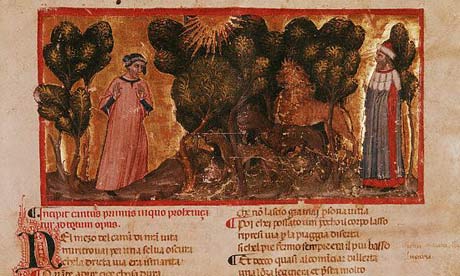
"Filósofos de Dios" y el Dante en 'The Guardian'
God's Philosophers by James Hannam – review
In canto XVII of Inferno, Dante anticipated the principle of Galilean invariance 300 years before Galileo. Even earlier, Islamic steelmakers in Damascus unwittingly exploited nanotechnology in the manufacture of sabres that became the envy of the world. So the middle ages weren't so medieval.Almost the only annoying thing about James Hannam's admirable book is his opening insistence on a conspiracy of "popular opinion, journalistic cliche and misinformed historians" to denigrate the middle ages, and he cites the compass, Columbus and the 1455 printed Bible of Gutenberg as advances of the middle ages. In this conspiracy, whenever someone discovered evidence of reason or progress in the 14th or 15th centuries, he writes "it could easily be labelled 'early-Renaissance' so as to preserve the negative connotations of the adjective 'medieval'." The OED gives no dates for the medieval period, but it tells me that the Renaissance began in Italy in the 14th century.
viernes, 18 de junio de 2010
Nuevo libro sobre filósofos medievales incluído en lista de la Royal Society
God’s Philosophers: How the medieval world laid the foundations of modern science
The Royal Society has unveiled its longlist for Prize for Science Books, the world’s most prestigious award for science writing, which includes a book about science in the Middle Ages. God’s Philosophers: How the medieval world laid the foundations of modern science, by James Hannam, debunks many of the myths and stereotypes about science and technological advancement during the Middle Ages, and profiles some of the important thinkers of period, such as Thomas Aquinas, Nicole Oresme and William of Ockham.
The five-member committee who made the choice said that Hannam's book "is a revelation, contradicting the popular idea of the Middle Ages as the “dark” ages, mapping key progressions during an era none of us associate with scientific advances and celebrating the lesser known mathematicians, 'philosophers' and anatomists on whose shoulders modern science stands."
Eleven other books also made the longlist, including Darwin’s Island: The Galapagos in the Garden of Englandby Steve Jones. This year’s longlist includes eight authors who are new to the prize, three who have been previously shortlisted and one previous winner (Jones, who won in 1994).
Maggie Philbin, Chair of the judges, said: “There were some fascinating books in this year’s entries, all of which explore science in very different ways. Narrowing it down to just twelve was very challenging and left us with a wonderful, diverse longlist that we’re all looking forward to really getting our teeth into. "
The shortlist will be announced on 24th August 2010. The winner will be announced at a ceremony at the Royal Society on 21st October 2010 and awarded £10,000. The authors of each shortlisted book will receive £1000.
God’s Philosophers has received very positive reviews since being released last year. James Hannan has also set up a website Medieval Science and Philosophy and a Facebook page to promote his book.
See also the Medievalists.net page for Aladdin’s Lamp: How Greek Science Came to Europe Through the Islamic World
Source: Royal Society

Suscribirse a:
Entradas (Atom)